Kilimanjaro summit night begins at midnight. You crawl out of your sleeping bag at Barafu Base Camp (4,640m), strap on your headlamp, pull on every layer you own, and start walking into darkness that feels colder and steeper than any distance you've ever covered. Nothing in your preparation — no training hike, no altitude simulation, no YouTube video — fully prepares you for what the next 12–16 hours feel like. This is what actually happens on Kilimanjaro summit night, from midnight departure to Uhuru Peak at 5,895m.
Loading content...
Why Does Summit Night Start at Midnight?
The midnight start is strategic. The volcanic scree slope above Barafu is loose and steep — in daylight heat, it's even more treacherous. A midnight departure puts you on the hardest section during the coldest, darkest hours but gets you to Stella Point (5,739m) approximately at sunrise — one of the most spectacular sights in Africa. It also gets you off the summit before afternoon cloud and afternoon deterioration in conditions.
Midnight to 2 AM: The Dark Hours
The first two hours are a rude shock. You've been sleeping at 4,640m — not restfully, because altitude disrupts sleep — and now you're asked to climb steep, loose scree in -10 to -15°C. The pace is genuinely slow: three steps, breathe, three steps, breathe. There is no option to rush. Your headlamp shows only the boots of the person ahead. The mountain above you is invisible in the dark. This is where many trekkers encounter their first serious nausea.
What helps: Eat before you leave (even if you're not hungry), maintain consistent breathing, and talk to your guide if you feel symptoms beyond normal discomfort. The guide carries emergency oxygen and pulse oximeters — ask for readings if you're concerned.
2 AM to 4 AM: The Wall
This is the psychological and physical crux. You're above 5,000m, the cold is at its peak, the summit is not yet visible, and fatigue is compounding with altitude. This is when trekkers give up — not because their body failed but because their mind decided the suffering wasn't worth it. The guides know this phase. They'll sometimes stop you, check your oxygen saturation, make you eat something, and talk you through it. Let them.
The trail switchbacks relentlessly up the scree. The headlamp bobbing line of other trekkers above gives you a reference point — you're not as far behind as it feels. The key is committing only to the next ten steps, not to the summit.
4 AM to 6 AM: Stella Point and the Crater Rim
Stella Point (5,739m) arrives just before sunrise on most summit nights — about 5:30–6:00 AM. When you pull yourself over the crater rim and see the eastern sky beginning to turn orange behind Mawenzi peak, and the Southern Ice Fields glowing ahead of you, something shifts. The pain doesn't disappear — but the context changes completely. You are on the rim of a 19,000-year-old volcano watching the sun rise over East Africa. Most trekkers weep here. It is appropriate.
From Stella Point, the path along the crater rim to Uhuru Peak takes 45–90 more minutes — another 156 vertical metres. The altitude is now critically thin. Conversation is effort. Each step requires focus. But Uhuru is visible ahead, and the knowledge that this is the last distance carries most people through.
Uhuru Peak: The Summit
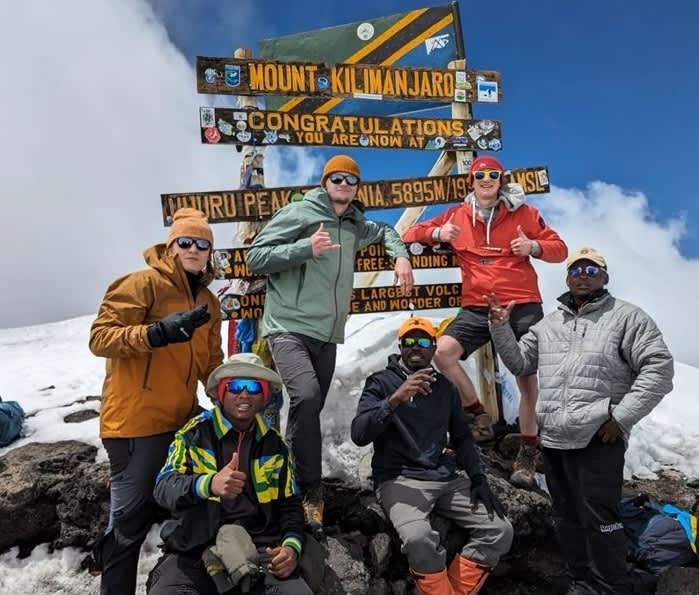
The wooden sign at Uhuru Peak (5,895m) reads: Congratulations. You are now at Uhuru Peak, Tanzania. 5895M AMSL. Africa's Highest Point. World's Highest Free-Standing Mountain. One of World's Largest Volcanoes. Welcome. Photographs happen in a blur. The Southern Ice Fields stretch behind you — dramatically smaller than historical photographs from a century ago. The summit temperature is typically -10 to -25°C with wind chill. Most trekkers spend 10–20 minutes at the top.
The emotional experience varies: some sob, some laugh, some feel strangely calm, some feel nothing at all — which is also normal at extreme altitude. Your brain is running on thin oxygen. Full emotional processing often happens on the descent when the oxygen returns.
The Descent — Often Harder Than the Climb
The descent via the Mweka Route is long (10+ km), steep, and physically punishing on knees and quads. The loose scree that made the ascent slow is actually useful here — you can plunge-step down at speed. Most trekkers reach Mweka Camp (3,100m) in 4–5 hours after departing the summit. The altitude headache often clears dramatically between 4,500m and 3,500m — the feeling of oxygen returning to your brain is genuinely euphoric.
What to Bring for Summit Night
- Layers: Thermal base, fleece mid-layer, down jacket, waterproof shell — minimum four layers on top
- Extremities: Liner gloves + heavy mitts, thick wool or synthetic socks, balaclava or buff, goggles (wind and UV)
- Food: High-calorie snacks that won't freeze solid — energy gels, chocolate, dates
- Hydration: Insulated water bottle or hydration bladder inside your jacket to prevent freezing
- Medications: Your Diamox dose, ibuprofen for headache, anti-nausea if prescribed
- Camera: Keep it inside your jacket — batteries drain in cold. Charge it the night before.
Book this tour
7-Day Machame Route Kilimanjaro — Scenic Summit via the Whiskey Route
Conquer Kilimanjaro on the 7-day Machame Route — Africa's most scenic ascent. 85%+ summit success rate, expert guides, all-inclusive from …
$2,395.00
View Tour →